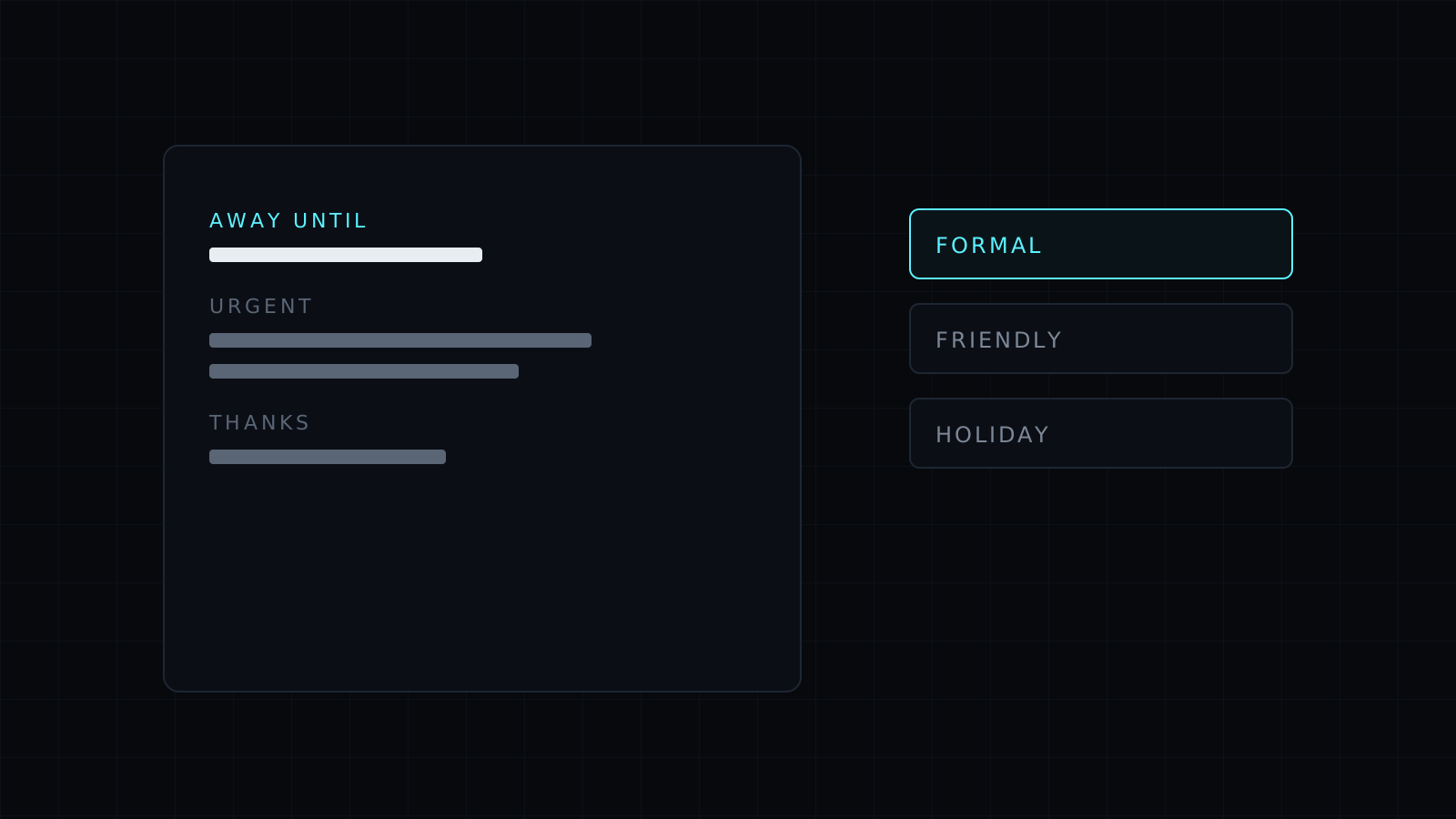
An out of office message is the auto-reply people get when they email you while you’re away, and this prompt writes yours for every situation in one go. You give it your dates, an optional reason, your backup contact, what counts as urgent and your tone, and it writes internal and external replies in formal, friendly and short variants, plus a holiday version.
What to put in an out of office message
Someone reading your auto-reply wants two answers: when you’ll be back and who can help in the meantime. A good out of office message gives the return date in the first lines, says what happens to the email they sent, and points urgent matters to a named backup contact. Everything else is optional. Long explanations and travel details rarely help.
Internal and external, three tones each
Colleagues and clients need different messages. The internal reply can be direct and mention a teammate by role. The external one stays professional and never mentions internal projects or confidential details. The prompt writes both, each in a formal, a friendly and a short variant, with a subject line under 50 characters. It adds a holiday version for the end of the year or a public holiday that doesn’t assume a specific religion.
Every reply puts the return date up front, follows your urgency rules and stays under 80 words, or under 40 for the short ones.
No oversharing, no gaps
The rules leave out travel plans, health and family details and locations, even if you mention them in the reason. The prompt never invents a backup contact, phone number or date; if something is missing, it marks it and tells you. It ends with a reminder of what else to set up, like your calendar status and a heads-up to your backup.
Who it’s for
- Anyone heading on vacation, leave or a conference.
- Managers who want consistent away messages across a team.
- Freelancers who need to tell clients clearly when they’re back.
FAQ
Should I say why I’m out of office?
It’s optional. Many people simply give the dates. The reason field lets you add vacation or a conference, or leave it out entirely.
Do I need separate internal and external replies?
Some email clients, such as Outlook, can send different replies inside and outside your organization. Where yours does, it’s worth using, because colleagues need more detail than clients.
How short can an out of office message be?
Two lines can be enough: the date you’re back and who to contact. The short variants are written for that.