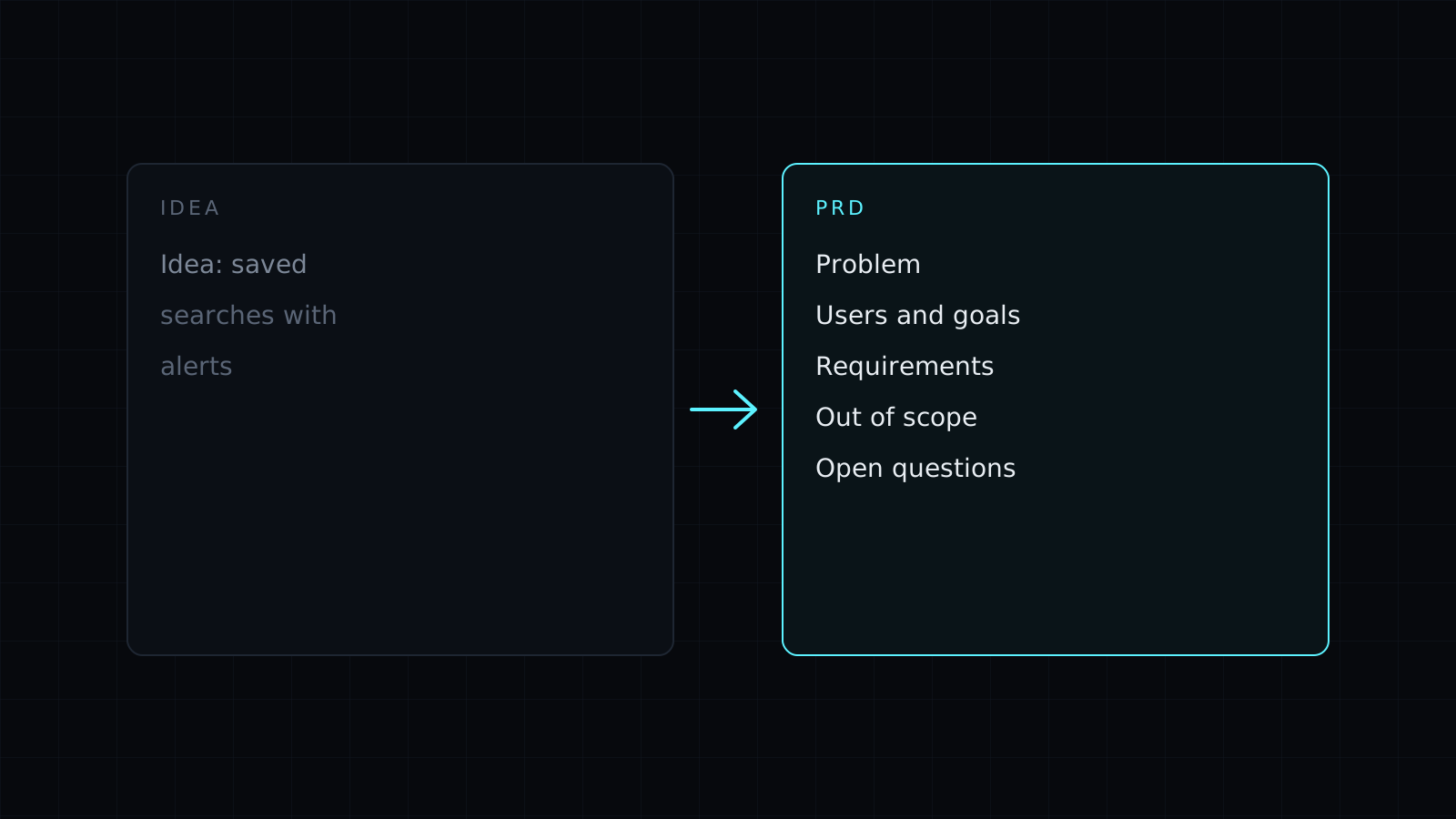
A product requirements document template gives you a list of headings; this skill for Claude writes the PRD itself, from an idea, a few notes, a customer request or a meeting transcript. You get a document that tells designers, engineers and QA what to build, for whom, why, and how everyone will know it is done.
What goes in a product requirements document?
A good PRD answers the questions a team asks before building. What problem are we solving and for whom? What does success look like, in numbers? What is in, and just as important, what is out? What exactly must the product do, and how will we test it? What happens when things go wrong?
The skill writes a section for each: problem, users and the jobs they are trying to get done, goals and non-goals, success metrics, requirements, user flows, edge cases, out of scope, open questions and risks.
Requirements your team can build and test
Requirements are ranked must, should and could, so the team knows what to cut if time runs short. Each one comes with acceptance criteria written so QA can check it: given a situation, when the user does something, then this happens. Vague lines like “the page should be fast” or “easy to use” become something measurable, or get flagged as an open question.
Edge cases get their own section: empty states, errors, permissions, limits, slow connections, the user who does things in the wrong order. Otherwise these come up mid-sprint.
Product requirements document template, filled from your notes
Like any product requirements document template, the structure is fixed; the content is yours. When your notes are thin, the skill doesn’t pad the document with guesses. It asks the few questions that change the scope, such as who the main user is, what the deadline is or which platform comes first, and then writes. Anything it still has to assume is marked as an assumption, with the person who should confirm it.
It never invents user research, survey results, baseline metrics or technical constraints. A PRD is a shared agreement, and an agreement built on made-up facts falls apart at the first review.
FAQ
Can it write a PRD from a one-line idea?
Yes. It asks a few questions first, then writes a full draft with the gaps listed as open questions.
Does it write user stories?
Yes. On request it turns the requirements into user stories or a list of tickets with acceptance criteria.
Is it only for software?
It is built for software products and features, and also works for internal tools, APIs and connected hardware features.