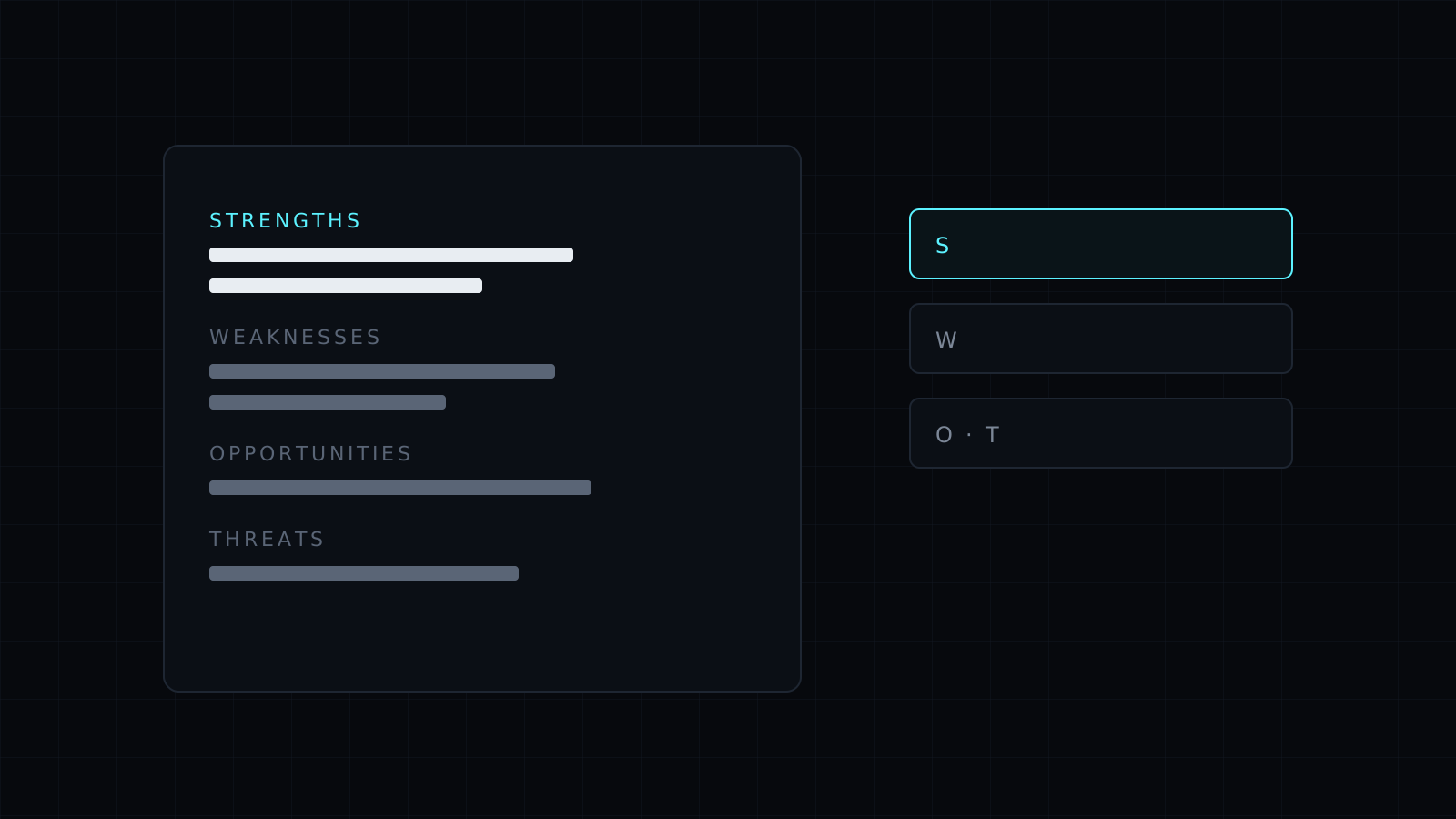
A swot analysis maps a business’s Strengths, Weaknesses, Opportunities and Threats, and this prompt builds one that ends in decisions instead of four lists. You describe your business, the market, your competitors, what you know about yourself and your goal, and it writes the SWOT, turns it into strategies and ranks three priorities.
How to do a SWOT analysis that is useful
The most common mistake is mixing up the quadrants. Strengths and weaknesses are internal, things you control, like your product, team, costs and processes. Opportunities and threats are external, like customers, competitors, trends and regulation. When “a new competitor” ends up under weaknesses, the analysis stops pointing anywhere. The second mistake is stopping at the grid. A SWOT only pays off when you combine the quadrants into actions.
What this SWOT analysis prompt writes
You get four quadrants with four to six specific points each. If something you listed belongs in a different quadrant, the prompt moves it and says why. Then it builds a TOWS matrix, two strategies for each pair: SO uses a strength to take an opportunity, WO fixes a weakness with an opportunity, ST uses a strength against a threat and WT reduces a weakness so a threat hurts less. Each strategy names the points it combines.
It finishes with three priorities tied to your goal, each with a first step and a sign that it’s working.
Facts you can check
The prompt never invents market sizes, competitor facts or customer numbers. Anything that needs data to confirm is marked so you can see it at a glance, and the answer ends with a short list of what to look up first.
Who it’s for
- Founders and small business owners planning the next quarter or a launch.
- Students and analysts who need a clean SWOT with strategy behind it.
- Marketers preparing a plan or pitch that needs a clear situation review.
FAQ
What is the difference between a SWOT and a TOWS analysis?
A SWOT lists the four factors. A TOWS matrix uses them together to produce strategies, pairing internal and external points. This prompt does both in one answer.
Can I do a SWOT analysis for a competitor?
Yes. Fill it in with what you know about the competitor and mark your guesses. Comparing their SWOT with yours often shows where to compete.
How often should I update a SWOT analysis?
Whenever something important changes, such as a new competitor, a price change or a new goal. Many businesses revisit it once or twice a year during planning.