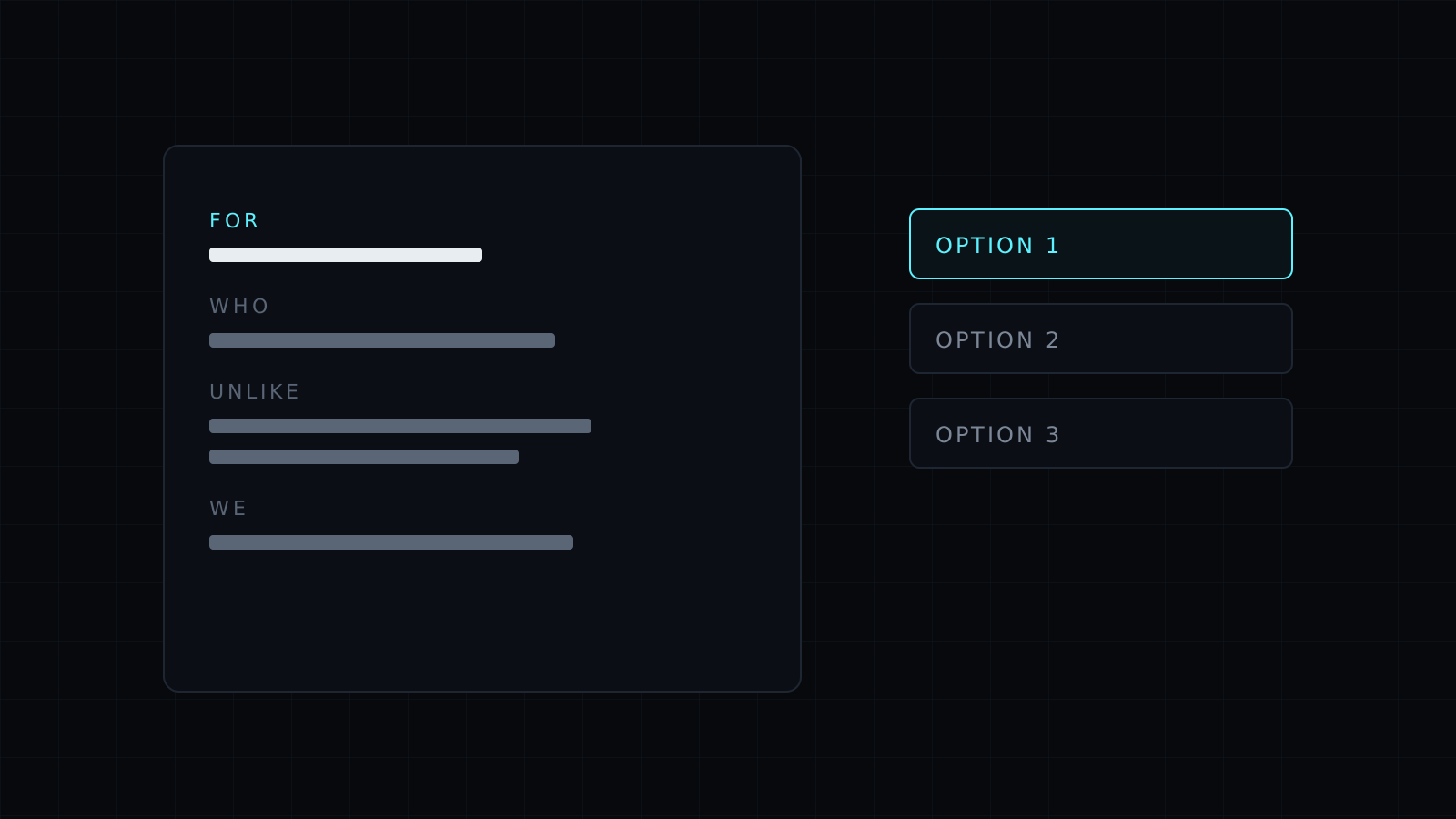
A unique selling proposition is the one reason a customer should choose your offer over the alternatives, and this prompt writes five options from different angles so you can pick the strongest. You give it what you sell, who it’s for, what they use instead, your proof and anything you do differently, and it writes each USP with a short headline version.
What makes a good unique selling proposition
A USP is not a slogan and not a list of features. It names who the offer is for, what they get and why that’s different from what they’d do otherwise. The last part is where most fail: “high quality, great service” could describe any competitor. A strong unique selling proposition is specific and provable.
Five angles, one pick
The prompt writes one option for each of five angles: the outcome the customer gets, the mechanism that makes it work differently, a specific audience the alternatives ignore, the risk you remove, and the speed or effort you save. Each comes in one or two sentences, with a headline version of ten words or fewer and the proof from your list that backs it. Where proof is missing, it marks the gap instead of covering it.
Then it picks the strongest option, explains why it beats the alternatives and says what proof would make it stronger.
No claims you can’t back up
Words like “best”, “only” and “number one” appear only when your proof supports them. Otherwise the prompt looks for a claim that is specific and true. It never invents results, reviews or competitor weaknesses, and it cuts empty words in favour of the language your customer would use.
Who it’s for
- Founders deciding how to describe a new product or service.
- Marketers rewriting a homepage, ad or pitch that sounds like everyone else.
- Freelancers and agencies who need to explain why a client should hire them.
FAQ
What is the difference between a USP and a value proposition?
A value proposition describes the value you deliver. A unique selling proposition focuses on what makes that value different from the alternatives. In practice they overlap, and this prompt covers both by stating the value and the difference.
What if my product isn’t very different?
Small differences count: a niche audience, a guarantee, a faster setup or a clearer process. Use the difference field for anything you do differently, even if it seems minor.
Where should I use my USP?
In your homepage headline, ads, sales pages, pitch decks and the first line of a sales call. The headline versions are written for those places.