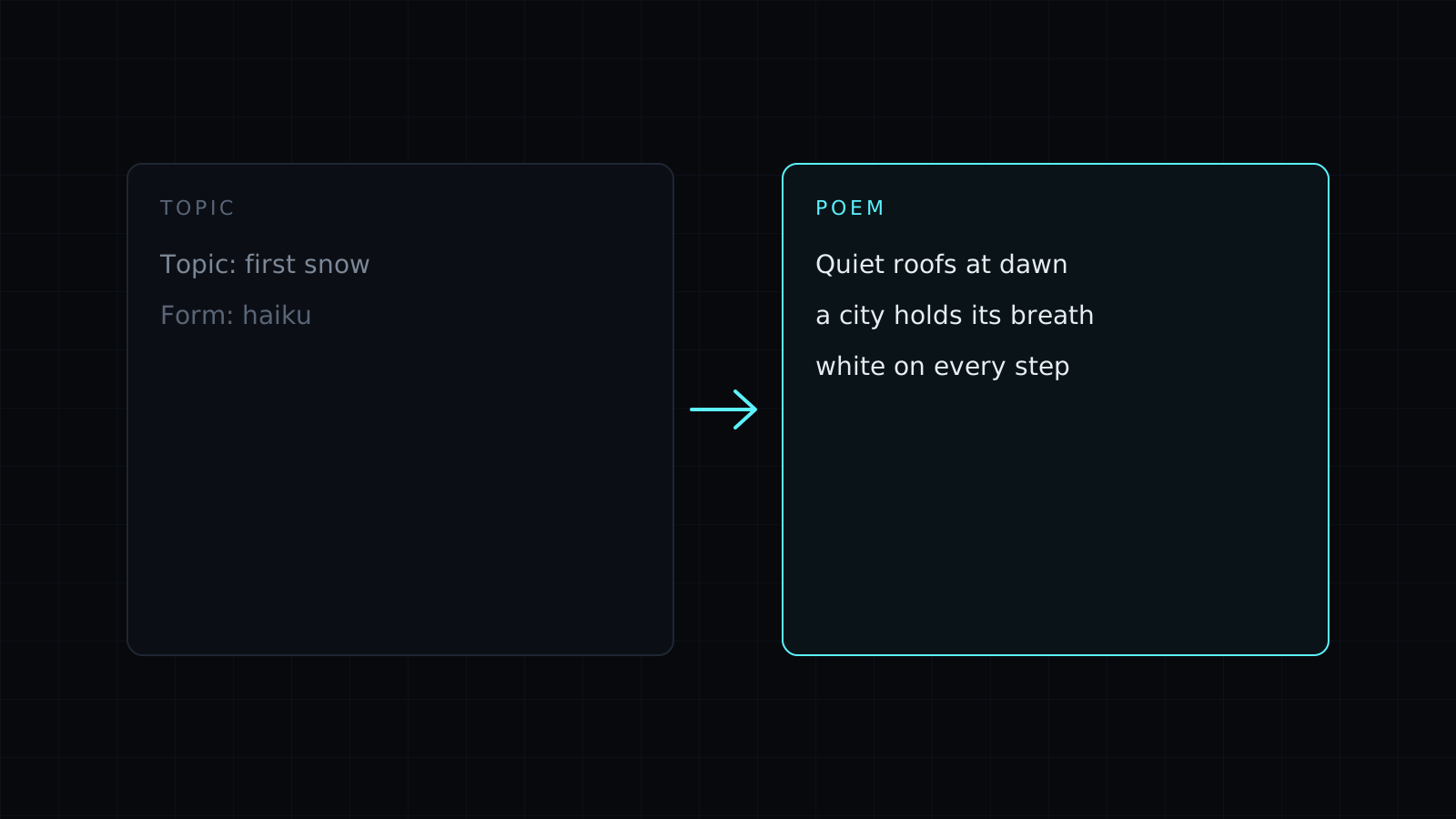
This poem generator is a prompt that writes a poem on any topic, in the form you choose: haiku, sonnet, limerick, rhyming quatrains or free verse. You pick the tone and the length, add real details if the poem is for someone, and it writes a titled poem that follows the rules of its form, then offers to revise it.
Why form matters in a poem
A poem generator that ignores form gives you lines that rhyme by accident and stumble when read aloud. Each traditional form has rules, and the rules are part of the effect. A haiku is three lines of five, seven and five syllables built around one concrete image. A Shakespearean sonnet has fourteen lines in iambic pentameter, rhymes ABAB CDCD EFEF GG and turns in the final couplet. A limerick rhymes AABBA with a bouncing rhythm and lands on a punchline. Free verse drops rhyme and meter, so line breaks and images do the work.
How this poem generator works
You give it the topic or occasion, the form, the tone, the length, who the poem is for and any details to include. It follows the form exactly: a haiku shows the syllable count of each line, and a sonnet keeps its meter and rhyme scheme. Under the poem it names the form, the rhyme scheme and the meter, and points out any line where it bent a rule and why.
For example, a funny limerick about a cat who steals socks reads very differently from a tender sonnet for a tenth anniversary. For the anniversary poem, add the place you met or a habit your partner has. The prompt uses only the names and memories you give it and never invents details about you or the people in the poem.
A revision built in
The first draft is rarely the last. The prompt ends by asking which line or stanza you’d change and suggests two other directions, such as a different tone, a tighter ending or another form.
Who it’s for
- Anyone writing a poem for a birthday, wedding, card or memorial.
- Students learning how poetic forms work by seeing examples on their own topic.
- Writers who want a draft to rework in their own voice.
FAQ
Can it write a poem that doesn’t rhyme?
Yes. Choose free verse and the poem relies on rhythm, line breaks and images instead of rhyme.
Why does my sonnet have a slant rhyme?
Sometimes a slant rhyme fits the meaning better than a true one. The prompt marks any slant rhyme it chose, and you can ask it to replace them with true rhymes.